
The AGILE 2027 Conference will be held jointly with the 5th Youth Innovation Forum (YIF) on Digital Earth in Lund, Sweden, from 21–24 June 2027.
Under the theme “Geospatial Intelligence and Digital Earth for a Sustainable Future”, the joint AGILE 2027 - YIF 2027 Conference highlights the transformative role of GIScience, spatial intelligence, and Digital Earth technologies in addressing complex societal and environmental challenges. The conference will foster interdisciplinary research, technological innovation, and collaboration across generations, bringing together established experts and emerging researchers to advance solutions for a more sustainable and resilient future.
We cordially invite researchers, practitioners, and professionals in all facets of Geographic Information Science and Technology and their applications to present ongoing research, showcase products, network with colleagues from Europe and the rest of the world, and find out about the latest developments in the field.
Topics of interest for submissions include, but are not limited to:
- Spatial Statistics and Geostatistics
- Visualisation of geospatial data
- Spatial Data Ecosystems
- Spatial Databases and Data Management
- Using remote sensing data in geospatial analysis and applications
- Web-based GI Systems and Services
- XR: Virtual, Augmented, Mixed Reality (VR, AR, MR)
- Data fusion and uncertainty reduction
- Semantic enrichment, ontologies, and knowledge graphs
- AI/ML approaches for geospatial analysis and reasoning
- FAIR principles, open data, and reproducibility
- Human-centered and participatory approaches to geospatial knowledge creation
- Applications: climate resilience, energy transition, health, urban futures etc.
The AGILE 2027 - YIF 2027 conference will have oral presentation sessions, three keynote sessions, a poster session, a best paper, a best reproducibility report and a best poster, as well as pre-conference workshops. Similar to 2026, we will run a published article session, showcasing presentations of articles already published in journals.
Information regarding registration and fees is shared on the respective page.
Important dates
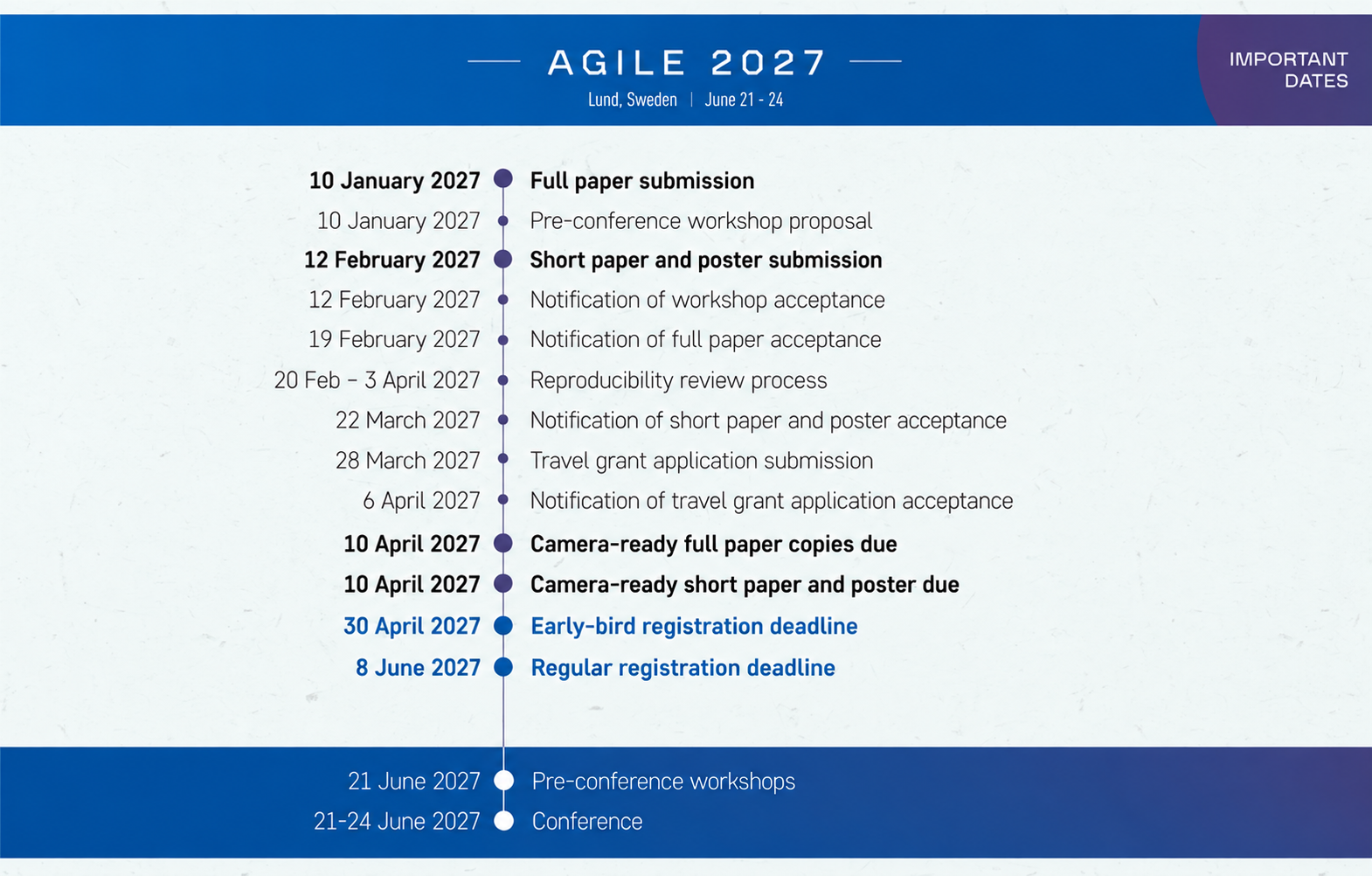
Submissions
Full-paper track
4000 to 6000-word manuscripts of original and unpublished fundamental scientific research. High-quality scientific submissions will be accepted for presentation at the conference and published open-access in the AGILE: GIScience Series of TIB Publishers.
Short-paper track
2000 to 3000-word manuscripts of original and unpublished research work. High-quality scientific and strategic (industrial and governmental) submissions will be accepted for presentation at the conference and published open-access in the AGILE: GIScience Series of TIB Publishers.
Published article track
300 to 500-word summary of articles published during the years 2024-2026 in a peer-reviewed scientific journal. Submissions should include a citation with a link to the published article.
Poster track
500 to 1000-word extended abstract of original scientific and strategic research work (please use the same template as full and short papers). Posters provide a good opportunity to stimulate scientific discussions and exchange novel ideas.
Education track
500 to 1000-word extended abstract on novel approaches in geoinformatics education. Since 2026, AGILE has introduced its education track, where educators and researchers can share their contributions and engage in exchanging ideas and best practices for teaching geoinformatics.
Submission guidelines
The submission of papers is via <to be decided> platform.

Full and short papers and posters must be prepared using either the Word Document template or the LaTeX Document template. Education track submissions follow the extended abstract template. Papers must be written in English according to the formatting guidelines. Authors must remove their names and institutional details from the title, header, and acknowledgements as AGILE 2026 is running a double-blind review process. Self-citations must be cited in the third person, such as replacing “As described in our previous work [10]...” with “As described by (Author Name) [10]...”. Further suppression of identity in the body of the paper is left to the authors’ discretion.
Reproducibility
All paper submissions must follow the AGILE Reproducible Paper Guidelines. The accepted paper must have a section describing the data and software availability. Papers that lack a data and software availability section will be rejected immediately and without review. More information on this section may be found in the templates.
The reproducibility chair invites all members of the AGILE community, but especially early career researchers, to self-nominate for the reproducibility committee. Please contact Daniel Nüst (daniel [dot] nuest [at] tu-dresden [dot] de) if you are interested in contributing to increasing transparency, reproducibility and reusability of GIScience research. See the Reproducible AGILE website for more information.
Submission type
When preparing a submission to the AGILE 2027 - YIF 2027 conference, we ask authors to add metadata to their submission. One new metadata field is called a submission type. Please choose all applicable types from the list below and add them / copy them into your submission after the term "Submission type." below the abstract. Your decision as to the type should be guided by the main contribution of the paper. Your paper might focus on the following content:
- theory
- model
- analysis
- dataset
- algorithm
- software
- project
- case study
- infrastructure
- other (please specify)
As an example: A paper describes the development of an ontology within the context of a project using a case study and collects data as proof of concept. With a focus on the description of the ontology, it could be classified as a "model". If the focus is rather on collecting the data as a basis for the ontology, then it might be classified as a "dataset". It is not a type of "project" since this is not the focus of the paper.
For any inquiries, please contact:
Organised and hosted by |
Collaborating Organizations |
|
  |
  |
|
Sponsors |
||
 |
